
Object Record
Images

Additional Images [2]
Metadata
Object Name |
Clock, Shelf |
Catalog Number |
81.19.3 |
Collection |
Timepiece |
Other Name |
Steam Engine, French Industrial clock |
Date |
c. 1880 |
Description |
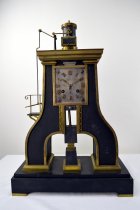
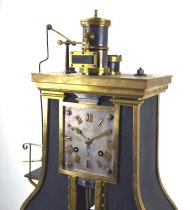
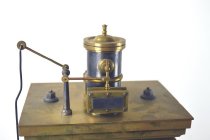
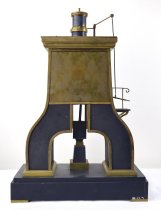
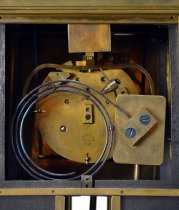
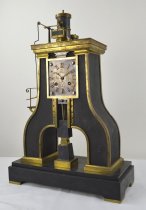
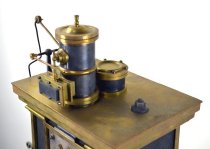
c. 1880 Guilmet steam engine shelf clock This is a French novelty clock, popular in the late 19th and early 20th century, that has the movement and dial housed inside a model of a steam hammer, though other industrial machines were popular. This clock, a model of the James Nasmyth steam hammer that was exhibited in the 1851 Exhibition in London, has a hammer that moves up and down with each swing of the U-shaped pendulum that is hidden within the hollow legs. A detailed description of the clock's hammer mechanism can be found in the October 1956 issue of the NAWCC Bulletin. The movement has a Brocot escapement and both dial and movement carry the number 79. Many of the parts also carry five punch marks. The hours are struck on a coiled gong. The clock was also available with a pair of taper candelabra in the form of rolling mills. |
Maker |
Guilmet |
Material |
brass |
Place of Origin |
Paris, France |
Notes |
Updated by Cara M. Lower 7/22/14 During the late 19th century and the early 20th century a number of French novelty clocks were made that had their movements and dials housed within models of industrial machinery. The models specifically were of steam engines, railway locomotives, warships etc. This sort of clock is often referred to as an "industrial clock". This particular example, a model of James Nasmyth's steam hammer that was exhibited in the 1851 Exhibition in London, has a hammer that moves up and down with each swing of the U- shaped pendulum that is hidden within the hollow legs. A detailed description of the clock's hammer mechanism can be found in the October 1956 issue of the NAWCC Bulletin. The movement has a Brocot escapement and both dial and movement carry the number 79. Many of the parts also carry five punch marks. The hours are struck on a coiled gong. |