
Object Record
Images
Additional Images [3]
Metadata
Object Name |
Clock, Carriage |
Catalog Number |
77.82.2 |
Collection |
Timepiece |
Date |
1900 |
Description |
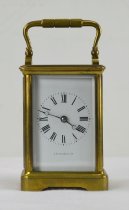
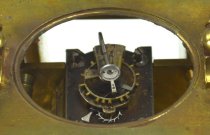
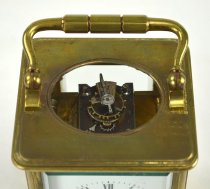
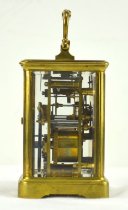
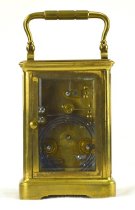
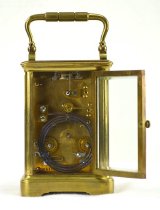
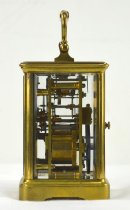
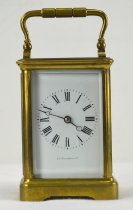
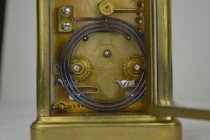
c. 1900. Duverdrey & Bloquel Carriage Clock. "J E Caldwell & Co." on dial, movement marked "Made in France", "J. E. Caldwell & Co. Philadelphia", "Hands", "16061", brass case with bevel glass sides, with brass handle and oval opening on top. Movement visible and accessible. White dial with black Roman numerals. |
Maker |
Duverdrey & Bloquel; retailed by J.E. Caldwell |
Material |
Brass, Glass |
Place of Origin |
St. Nicolas d'Aliermont, France |
Notes |
This clock was made for export to America and is marked on the dial "J. E. Caldwell & Co., Philadelphia". This carriage clock is well marked by the French maker with the name of the retailer, but is not marked with the name of the maker, which was a common practice at the time. Large, big name jewelry retailers such as J. E. Caldwell, Tiffany, and others wanted to give the impression their own company made the clocks and jewelry bearing their name. J. E. Caldwell & Co. of Philadelphia was founded in 1839 by James Emmot Caldwell (1813-1881), and was, and still is, one of the most reputable retailers of silver, china & jewelry as well as other fine art objects. The clock connection to J. E. Caldwell & Co. was due to his employment as a watchmaker for the John C. Farr & Co., an importer of watches and manufacturer of jewelry about 1837. This led to Caldwell opening his own retail store at 136 Chestnut in 1839. The company is now located at 728 Samson St. in "jeweler's row", Philadelphia, Pa. The company is now over 177 years old. Many carriage clocks can be identified by their movement design and the "punchmark" showing the hands and winding direction, as well as other markings placed on the movement by the maker. These markings allowed me to identify this clock as being produced by Duverdrey & Bloquel. Duverdrey & Bloquel Co. made and sold this clock, and many others, direct to the J. E. Caldwell & Co. to be retailed in America. This carriage clock is a production carriage clock made for export to America and other countries. The clock style is generally referred to as "cornish" in a standard size. This is a style used by several other well known carriage clock makers which had factories in the St. Nicolas d'Aliermont, a region near the French border with Switzerland, separated only by the Jura mountains. Many of these French carriage clock makers purchased escapements made in Switzerland to complete their carriage clocks. I have not been able to closely examine this escapement, but it is a common Swiss designed lever escapement used by many French carriage clock makers . The movement is known as a "time & strike" model designed to run 8 days and strike the hour and one strike at the l/2 hour. This style was very popular during this period, the 1890-1910 "hey-day" of production carriage clocks being made in France, American and Germany, where competition was very keen between the makers of carriage clocks and traveling alarm clocks. I believe this carriage clock was made circa 1900-1910. Duverdrey & Bloquel, St. Nicolas d'Aliermont was formalized when Joseph Bloquel joined Paul Duverdrey in 1910. They took control of a factory which had been started by Alvert Villon in 1867. The company made complete carriage clocks before and after the death of Villon in 1910. In 1922 the company adopted the trademark of a lion with 3 feet on the ground and one foot lifted. The name was changed to Bayard & Co. about 1947, but they still marked their clock movements with the lion and "Duverdrey & Bloquel". The company was still in existence in the late 1990s. Several "Duverdrey & Bloquel" carriage clocks are marked with other names such as finisher/retailer "Richard & Co.", and retailer "J. E. Caldwell & Co.", as well as many other retailers in the USA & Europe. (Courtesy of Ken Hogwood, FNAWCC) |