
Object Record
Images
Metadata
Object Name |
Clock, Wall |
Catalog Number |
93.23 |
Collection |
Timepiece |
Other Name |
Lyre Clock |
Date |
1820-1840 |
Description |
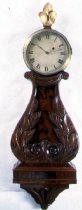
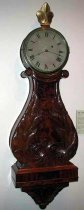
Mahogany lyre shaped case with carved leaf and scroll front panel. Rectangular base with a tapered carved leaf panel below terminating in a finial. Carved and gilded tri-part leaf finial at top. Brass bezel with glass over dial. Painted iron dial 8.625" with roman numerals. The attribution of this clock is based on the similarity of the movement design with that of another lyre clock signed by David Wood. Wood set up his shop in Newburyport in 1792 and in 1824 he was selling both old and new clocks of every make. The Lyre design can be found as a motif in both furniture and clock design. It was used estensively in France at least a century before. Cabinetmaker Duncan Phyfe used the lyre design so much during the first half of the 19th century, it is practically synonymous with his name. Various American makers have been credited with "inventing" the lyre wall clock, most often sited is Sawin & Dyer, however there are no existing patents to document this. An 1839 advertisement of Swains' does mention an "elegant Harp pattern clock" which is probably the lyre design. The Lyre Wall Clock can be found variations using a reverse painted tablet at the center of the lyre, a plain mirror, or mahogany panel as in this piece. Another variation is the use of a rectangular base with a door rather than continuous carving. |
Maker |
Wood David Attributed |
Material |
brass 8 day |
Place of Origin |
Newburyport, Massachusetts, USA |
Notes |
A 34171 23 slides in slide cabinet 1 Eight-day time only movement. Brass rectangular shaped plates tapering to a beehive shape above the winding arbor. Anchor escapement between the plates with the crutch extending thru a circular opening in the front plate. Painted iron dial, 8 5/8" in diameter, unsigned. Mahagony lyre shaped case, with carved leaf and scroll design . Mahagony panel in front . Rectangular base with a tapered carved leaf panel below, terminating in a small "D" shaped finial. Carved and gilded tri-part leaf finial at top. Attributed to David Wood, Newburyport, Maine. Circa 1830. Updated by Cara M. Lower 8/7/14 |